
Reflecting on What You May Become: Research, What Have We Learned?

There is (of course) an online planner for reflecting on how you can round out your skills to become a better researcher overall. It is Vitae’s Researcher Development Framework, which is something that I, interestingly, once reflected on a great deal but then had a go at when I had lost all interest in it, for the simple reason that it was 2021, Covid arrived, my PhD course was suspended and my imminent medical retirement began to be openly discussed. I was basically, to all intents and purposes, past it. I once wanted to be Indiana Jones, and later Lara Croft, and if that failed, I wanted to be a Librarian; not only did I actually, kind of, do that, minus the whip/Lara bit, I also had a lot of interesting stops along the way, and discovered that I had a very specific set of skills that employers do utilise, but not always in the way that I expect them to. I then became a mother with a mortgage, and kind of stopped caring, as long as I got paid and my mind was engaged. Don’t get me wrong, I have had a cracking career, with some lapses, but I learned that dreams are not always what you are good at, or even initially believe you are really interested in; mostly what you want is to get paid, keep your family going, and not have a terrible time at work.
One of the jobs I was good at was creating projects for the long term unemployed; I successfully applied for and managed millions in European match funded monies along with other bid experts in my workplace. Would I be afraid of applying for funded money as a researcher? No not really. Does this make me an expert in this section of the research skills breakdown? No, interestingly enough, because this is just one third of the skills needed for the overall section this element falls into. The other two areas are research management, the skills for which seem to be inherent in the actual PhD completion (and therefore kind of immaterial for this personal assessment I am attempting), and professional conduct. The description for professional conduct is where I feel I could really use some development in this category, as it has a slightly different set of descriptors from those I would expect to see attached to say my employment. While the principles are the same, the details are very different, so ethical working in employment can be miles away from adhering to a board of ethics within the PhD structure in an educational setting for a piece of work that will be internally and externally verified; I am already fully aware of that just from looking at the paperwork. While I am a big believer in transferable skills (I would have to be at this point in my educational life), there still has to be a transfer process and a capable someone to assist with picking it up. The researcher element of professional conduct includes aspects such as co-authorship, which rarely even occur in employment; collaborative working is far more the standard than a co-authored piece. I think this therefore has to be considered a prospective personal weakness under the game rules I am setting myself. For one thing, yes I believe in professional conduct, but I believe more in making myself heard if you’re dealing with bias and things that are just wrong. Yes even to the point of getting the sack.
One of the things I have found most amusing about this exercise so far was that my strengths were clearly heavily weighted across two of the four areas, both of which relied on personal implementation with no networking or engagement. I can work as part of a team, I am even considered fairly good at it when I make the effort. That’s the nub though, I have to really make the effort. I would far rather work alone, completely independently, or simply be in charge, as I pretty much always end up thinking I know best once I’ve had a clear idea or concept anyway. I almost always end up in independent or management roles in work for the same reason; that’s just who I am. I am a good team leader, I like people, do not find line management particularly onerous having completed HR tasks in nearly every role for over twenty years, but I also now avoid higher management roles, even at the cost of higher pay, as getting them means I only line manage, and start losing my precious projects and ideas as a result. It also means I may have to follow policies that I simply do not agree with. This means I have also had to question mark all the ‘engagement and impact’ bits of this researcher framework, because I never push myself to bother with them, I just like the thinking. As I have gotten older, I have been able to pick and choose the bits I like and want to do, and I have had the temerity and standing to argue for them too. I realise this may have resulted in my doing things because I want to, not because they progress me in any way. On the other hand, twenty-five years wandering around doing things because I feel like it (and I am insatiably restless and nosy) has knocked quite a lot off this list by accident, so it completely depends on how you look at it. Obviously not everything I have involved myself in is that useful, even I am not that sure how I can argue my Level 2 Aromatherapy qualification following a three-month bored stint into PhD usefulness, but still. Health and Safety and Risk Management maybe? What I can say is I’ve spent hours using this qualification with my children. If you are serious about by the book progression though and being a fully rounded researcher rather than whoever you really are and want to be, there is a downloadable action plan you can complete to get guidance. I have a nasty feeling it may include engagement of some kind.
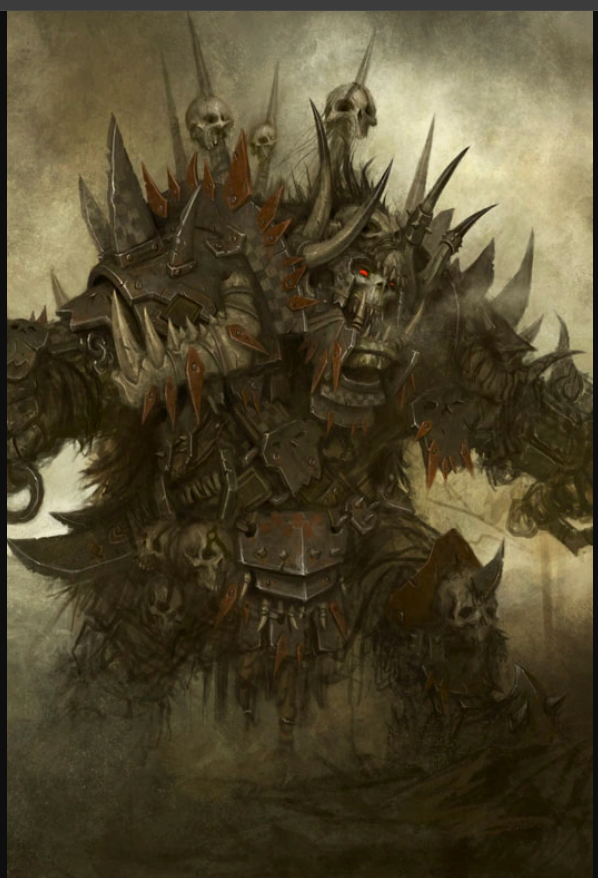
Like a mind map, or maybe Dirk Gently’s Holistic Detective Agency; everything is apparently connected, and leads to the next interesting element of play, a little like in a well-written RPG. I had a really bad migraine episode recently, which makes it difficult to think clearly, and I had been struggling with stress management, when my partner suddenly announced he was resurrecting an interest in Warhammer, and was going to shop for a starter pack. Did I want to engage? No, I stated. Absolutely not, I literally had no head space to take on anything else, up to and including painting and playing with tabletop gaming. Still, it was gaming, and banning the light with large glasses I trudged out with him for a look, despite mainly wanting to sleep.
A couple of hours later I had, despite the slow memory and brain work left after a migraine episode, engaged with the ex-videogame concept artist now running the Warhammer shop and his avid gamer colleagues, and was now possessed of a box of orcs, paint, and a codex, with a promise of further discussion on the links between tabletop D&D and videogame concept art over initial T’au vs Orcs skirmishes once our first armies are painted. I had also been handed two new games to look at for their narrative development, that the team felt had been sadly overlooked due to a lack of interest in narrative by devs over the last decade, and become fully informed on how the writer of Warhammer had been involved in the writing of Guardians of the Galaxy. My partner sniggering and my bank account reeling, I resolved to just stay in from here on in, so proving old researchers never retire.
If you are setting out at PhD level, I think one of the things you have to learn is that previous approaches to writing just aren’t enough. Basically, right up to postgraduate level, if you could write something decent, you were going to get a decent mark, it kind of went without saying. You certainly were not going to get 58 polite but determined rejection notifications that is for sure. I would argue that an above average ability at English, to some extent, covers up a lack of knowledge in every other subject; this has in fact been one of my biggest bugbears with the British educational system throughout my entire educational life, flying in the face of the fact that English is, indeed My Skill. It was not many of my friends, family members, or subsequent students’ skill, despite them being fantastic at their chosen vocation. And let’s face it, if you are going to buy a house, do you honestly want that house built by someone who answered their test questions in really good English, or do you want the guy who very quietly in the background built the very best houses? The issue with this is in how to test people vocationally without also testing their written skills; it is also in the question of how effective someone can be in the workplace with no communication skills and no ability to pass on the information regarding what they have been doing to, for example, your plumbing, car, house, or electrics.
At PhD level though, a certain level of English ability is so anticipated, that it is practically disregarded, and the focus is back on (yes, the subject), but also the assignment brief. This is now so advanced that it is at the point of being a reimagined skill, and must be, to all intents and purposes, fully relearned. Pass me a subject that I can muster any element of interest in, some spare time, and a keyboard, and I can write you something. Provide a brief even, and I would have claimed, probably accurately, that I could write you something against it. The issue is the level of the brief in question, and this was, well, pretty up there, and it was slippery. It also doesn’t really want a bit of information, it wants full on microwaved brain particles that make you begin to doubt you even bother looking at any subjects, let alone study them. Also do you have any proof, thank you very much, because no your word is not law, and we’re pretty sure there’s some gaps, and that is not fooling this paper, nice try though.
I think the hardest element though, is the framing of the work, and it could be that this is the slippery skill that I need to fish out from this whole mess of an eel pie. I do know that I struggled even more with subjects like paring down the research questions, which is really about framing the work, than with anything else. The final submission of mine that made it through to completion was not a plethora of new work. What it did have was a whole new angle, as if it had been turned to look through a new window of light, combined with the removal of superfluous work so the content was controlled. I also know that where I was trying to open my research questions out, thinking “I am never going to have enough to write”, in the accepted question set I instead reined them in and gave them fences, because I had begin desperately thinking “the potential here is out of control and there is no way I can manage it”.
Possibly one of the reasons for my divorce, in all honesty, could have been my ex-husband’s cleanliness, or conversely, my lack of interest in it. He was willing to stay home until the house was clean, when the sun was shining, while I saw this as an absolute waste of life - in this, we were complete opposites. Many of you would be horrified if you saw our house, or even just my desk. Games are piled everywhere. Paintbrushes and watercolours are mixed with Gelli plates and packed lunch boxes and Magic the Gathering cards, now with Warhammer models piled carefully on top. Things teeter. I dare you to ask any of us where something is. Here’s the interesting bit; if we are still interested in it, we know where it is. To the millimetre, even. If it has lost our attention on the other hand, then it’s gone, possibly (to be fair) never to be found again.
My mind mapping documents are like that; they make no logical sense to anyone else, and they sometimes make none to me either, and yet my brain somehow pieces it together anyway. I read somewhere once that creative or artistic people sometimes (definitely not always!) function better in chaos, it creates more ideas or better flow, I forget which, but the idea was that the odd concatenation of items allow your brain to put new concepts together without effort, which potentially led to new ideas. This draws me to my middle daughter, who is the scruffiest person on the planet, and will drag everything out of her drawers if necessary to coat her room in mess. If asked why, she will tell you that she just likes it. She has one of the snakiest twelve year old imaginations I have ever conversed with, and paces around a clean room with heightened stress levels, like some kind of caged tiger. I have no idea how she copes at her dads’, but hopefully she is learning the basic home hygiene she is probably never going to get from us.
The beautiful, sterile clean rooms that you could easily move around were very handsome, but I remember that for me they just seemed to stop the flow dead, and that was one of the driest creative periods I ever experienced. The only interesting thing I ended up making was occasional food. The frustrating thing is, I seem to feel my own lack all the time. I want this mindmap document to be organised, and understandable, but it just isn’t, in the same way that I want my rooms to be beautifully tidy and for me to still be able to create in them, which I can’t, and simply don’t. I suspect this is likely to be a metaphor for the whole PhD journey; we have in our minds an outline of what we want, but what we are going to get is probably going to be significantly different. While we are in control of what we research, we cannot change who we are, and we cannot change what the results are going to be, and we are continually crippled by our own self-judgements; all things we need to find the tools to control and overcome along the way.
