
Research is not conducted on the moon…

The first component of a PhD is the PGCert, a short initial qualification that focuses a new researcher on developing the skills and stamina needed to achieve the PhD stint, manage the research, and prepare for the completion of the work that will be needed practically as part of the thesis. I was a part time learner, so most of my research, and also my learning for the PGCert, was completed from home. For the duration of the PGCert, it is an odd limbo to be in. Full time students are there at the university, attending weekly sessions on the PGCert on a Wednesday, and completing hands-on work as they go. In my actual real life though, I had to wait until the session was uploaded on Moodle post-Wednesday, then around work and family, examine the material (hopefully coming to the same conclusions?!?! The chance I may not have had not occurred to me until I just wrote this down??!), and then complete the work I think is best. I would find myself oddly rushed, lagging along a little like a dragged helium balloon - part time, but still bobbing along full time weekly to keep up for this one component, with extra pressure because of the wait for the post-Wednesday upload, which made Mondays and Tuesdays really exciting I can tell you.
The first couple of weeks of the PGCert content focused essentially on gathering data, and sharing research. It is the onus on sharing research that really got me thinking, and we may need to settle in for this, because I started my degree in the adult learning section (TILL) of the University of Sheffield in 2000, so my association with Higher Education now spans 19 years of changing research times, and I have every intention of sharing those with you. In the interests of supporting student research, obviously.
I completed my BSc (Hons) on a part time basis around work, and I started part way through the first year (apparently we had now accelerated to a situation in which people were keen to have me! How wonderful! This may have changed when they realised how opinionated I had also become). As for adult learners at that time it was structured in such a way that it was perfectly acceptable to accrue credits compiling units towards a year. This meant that three calendar years could reasonably end up accumulating towards one full time academic degree year. It might still be like that now, I honestly have no idea. The intention though was the usual basis, that part time was half full time, and two years part time would make up one full time year. My degree therefore took me seven calendar years, around work and life, as that was the fastest I could achieve it, having started part way through an initial year.
Each unit had a credit rating, say of around twenty credits, and a set number of credits had to be achieved for each academic year equivalent. Each unit had a number of classes attached, that were all evening based, and were open group sessions. Here we were provided with leads, discussions, references. We also had papers and booklets containing reading lists, references, the usual support mechanisms that were paper based. Remember this is during the period 2000-2007, so computers are available, but the internet is certainly not as open to use as it is now. I am embarrassed to say it is taking me an effort to recall the limitations, but I know there were many. I had a home PC in the corner under the stairs, and I did have dial up for a while later on, but research was still basically paper based. You could retrieve information from the internet, but that in itself took time and effort, you had to understand what you were doing and how to do it. Television and video provided a valuable source through documentaries, if you could ensure the provenance was solid. Obviously, the BBC was considered more trustworthy then than it is now. The result was that, while we as students often attended the library together to research, and we often even helped each other find material, this tended to be in answer to each other's direct questions; we had very little idea what we were each writing about, and how that fitted in with what we ourselves were doing. The research itself, I would say, was really not shared. The library would have systems for cataloguing a dissertation as it was submitted, and that would be put on the shelf, and this may later be taken by students looking for an answer in that area of research, but that was the limit for all that work. My real point is, once that dissertation went into that archive, there was no reason for any future student to know it was there. As a student, you have to learn you can search and use the database of dissertations to even access that very recent research bank again. Is that a waste, do we think? (During my Masters, we were told as part of our Digital Cultures work, we were to make completed work accessible online to other research students. Access could include locations such as Academia, but a free, self-constructed website was suggested. Sharing in this way is not a usual process, in this case it was a result of the subject matter in digital cultures and the open mindedness of the excellent course tutors.)
What we were great at on our degree course was sharing potential leads, engaging in open class discussion and debate, and providing both practical and moral support to each other. When I was admitted to hospital and miscarried my first pregnancy, my friend reorganised my university workload, took all my notes so I scraped through the unit, and had public arguments with anyone mentioning my non-appearance in class. Two more miscarriages later, I discovered I was always going to miscarry without heavy duty medication, thanks to a rare blood disorder. I was actually disabled, it was just a very insidious disability that I was carrying, in which I can appear nothing short of disgustingly healthy, until I am suddenly not. I became pregnant again unexpectedly just in time for my dissertation, which when rooted in Archaeology was supposed to be a field study. Informed there was absolutely no way it was going to be acceptable for me to wander the moors in my condition, and with the need for regular, timed and injected medication, I was permitted a desktop research study, but warned this could affect my mark. At the same time, my supportive friend, in her turn, told me she was quitting at the point of her dissertation due to a family death. I may not be able to wander cheerfully around the moors, but I could certainly help with this. I stalked her, ringing at random hours to check her word count, driving over to ensure she was writing things down, taking her work off her so I could edit it. Possibly hating me, she gave up in the face of sheer stubbornness, and somehow kept on writing. Relieved, I turned my attention to finding some more inventive research of my own in the hope of getting a grade.
As I had to be innovative, I suddenly found myself driving to places like Hull Archives, where I could access direct material such as the original maps and Victorian surveys of the cart burials I had decided to research. I paired this with (had I but known it at the time) some cutting edge work in the design of my own Microsoft Access database using skills gained in work, in which I gathered and then compared all the animal remains existent in supposed cart burials across the UK, with particular reference to Yorkshire cart burials. The completed research contained a disk with the Access database enclosed, that I had professionally bound and stamped in gold; it was a desperate moment seeing the university copy vanish into the archives. I have no idea if it has been drawn out of its dusty shelves since. The bound copy that I had made for myself, unable to bear the thought of parting from it fully, was shoved underneath a cabinet at home wrapped in shrinkwrap. Despite the potential for an impaired mark, I came out with a 2:1, and missed graduation for the birth of my daughter. Finally admitting she hated me (I made a note to post chocolate), my friend attended for her graduation photo, and gave me all the gossip of the day by phone while I was in hospital.
I have shortened this seven year story of course, or this blog would be impossible, but I imagine that you are already seeing the missing thread. Shared research? What’s that? We might as well each have been researching on the moon. There were some common elements. Our dissertations were hidden in a dusty archive, accessible in paper form by later groups of beleaguered students willing to learn about their existence, then search them, and then read them. We did work together fairly intensively at times, especially on field research. We shared research, if by that you mean sharing books, leads, and talking to each other, often about arguably non-related items. We were mature students, with massive life events outside of education, to whom education was in fact a secondary concern, at best. In that seven year period, I met my first husband, married, moved house twice, was promoted until I was overseeing employability at a regional level, finally gave birth to one of my children, and had my first brush with the concept of serious health problems. All of that gathered experience and perspective informed my work at a human level, and over time has made me see things differently - it still is doing. During that seven year period though, there were two incidents that for me stand out, and underline the issue. If you are still with me, I will describe them as briefly as I can here.
Incident One.
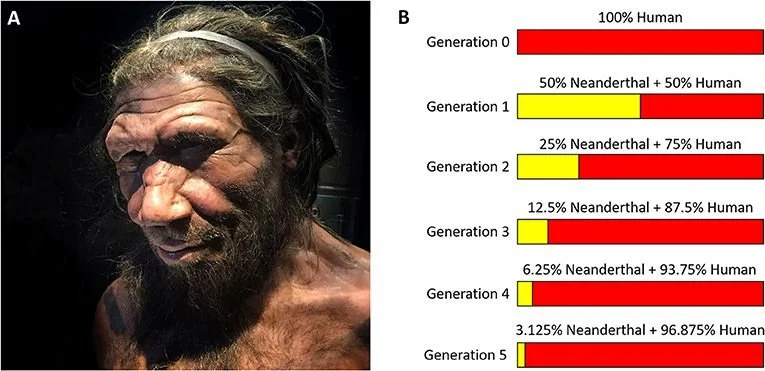
We were asked to write a piece about the Neanderthals. At the time (maybe 2004 ish?), there was a huge onus on new evidence that showed not only that Cro-Magnon man co-existed with Neanderthals for a very long period of time, but also newly released DNA evidence, that showed Neanderthal DNA was too far removed from Cro-Magnon man to successfully interbreed. The example used at the time was that of the horse and the donkey. The mule and sterility ensues. Remember that my work background was a sociological one. When I submitted my assignment, it caused a row, as I had firmly hypothesised that cross-breeding, or at least attempts at such and therefore interracial relationships, would have ensued amongst any peoples co-existing for that length of time. Sterility or not, I did not care; people intermingle, we cannot help it. Any other way forward just made no sense to me. I had used fiction novels and popular culture to help build a case for others subconsciously thinking the same, despite the DNA evidence of sterility. I cannot prove my case now, as I lost my work and notes a few years ago in another life event and now only have my dissertation, but cutting a long story short, it was more recently proven that the early DNA testing was flawed. All of us carry Neanderthal DNA; they did not vanish, they are right here now, in us. Interesting note, finding this out all these years later actually did not make me feel validated, I was just upset for days afterwards that my beloved academia had utterly dismissed my opinions.
Incident Two.

This involves my first meeting over the writing of my dissertation. Everyone looked a bit embarrassed, and then said, it’s coming along really well. And I thought, that’s great, why is everyone looking so glum? Then someone said, did you read the academic journal sections I sent you? Yes I said, they are really hard going. You have to concentrate to understand. Faces cleared, instantly. They said, your writing is very clear, very engaging, and very easy to understand. It draws everyone in. Anybody can read it. I said, is that not the point? No, that was not the point - the point of academia is that it is for academics. This is actually a trick that I was taught more forcibly but the opposite way later on, when I completed my teaching degree, but what I was being told was that I had to make my work less accessible. It was not fit for audience, in that it would not be fit for publication in an academic journal, because anyone could read it. It was very wrong of me, because this was just the way that you were taught at the time, and academia had weight to it precisely because of this, but I lost it. My whole work ethic was based on improving people’s circumstances by improving accessibility to opportunity. I saw this as a complete joke, and I became snarky as a result, eventually leaving the meeting with my hands shaking in rage. I did calm down enough to up my language game slightly for the dissertation, but just could not bring myself to go any further, so it is what it is and I took the mark given.
I am leaving these two incidents open to interpretation. Writing them down has certainly helped me reflect, and I (now) think I know what the issue is in my own mind, but feel free to remove the emotion and compare this to more modern knowledge of education now, twenty years later. Are things different? Some years ago, I finally managed to access that shrinkwrap copy and post my dissertation online onto Academia, and despite its age, it has been read regularly. Last year, I managed to convert the Access database, and posted a free online, usable version of that too. It has been used even more since, despite its age. Just interest, or are these students completing research, even if potentially at an introductory level, that can be used by other researchers looking for quick, basic information? What provides the greatest sense of achievement following three or more years of work?
